

Early in my career, I was forecasting sales for a digital content company and was constantly frustrated by how little data we had. I’d build models as best I could, but honestly, no one, including me, had much confidence in them.
One day, I told our head of data science, a brilliant guy with decades of experience, that our forecasts felt basically unusable. He looked at me and said something that completely threw me:
“Go hang out with the business development team. Ask them how they think the content will do and what the curve will look like, and use that instead.”
I was shocked. That goes against everything you’re taught. The standard playbook says: clean the data, add more history, engineer better features.
But we didn’t have time, and what I didn’t get then (but he understood perfectly) is that there’s a ton of information hiding in what looks like a random guess from someone who knows the business. These people talk to customers, follow trends, read the news, and spot patterns that never show up in a dataset but are incredibly valuable.
And funny enough, some of those “dart throws” from the biz dev team ended up being the most accurate forecasts we made that year.
The new idea: a forecast that talks back
Now in the age of generative AI, you can take inspiration from this story but do much better. Your AI assistant can look at your time-series training data for sales forecasting and ask questions about it, just as I once bugged the biz dev team.
“These ten days in September look off. Was that a promotion?”
“Do you expect another like it next quarter?”
“Any holidays or campaigns coming up I should know about?”
“That spike on Friday, was it a new product launch, or a data quality issue?”
The AI turns forecasting into a dialogue, combining its pattern recognition with your context. You correct it, clarify, and enrich it, and each answer feeds back into the model.
Let’s try it out.
Experimenting with this concept
Goal: In this small experiment I measure how much I can improve the accuracy of a 2025 orders forecast by conversing with AI about things I expect to impact order volume for the year.
Step 1: Training and Testing Sets
I generated a training set of data from 2023–2024 with daily granularity and just two fields: date and orders. This is the base case of just having a historical curve to predict the future.
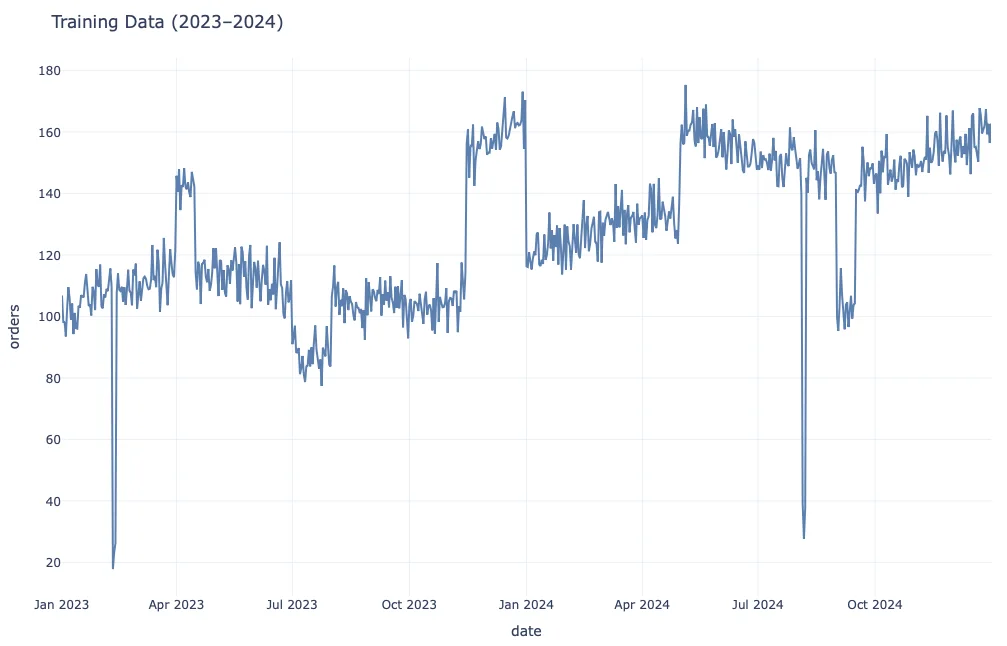
I made a short list of things I already know about that period, events that clearly influenced order volume, but I don’t label them in the data.
Here are the things I know about 2023-2024 (reflected in the graph):
A spring promotion in April 2023 gave orders a sharp bump.
A mid-summer slowdown in July 2023 reflected vacations and reduced marketing.
The holiday build-up in Nov–Dec 2023 produced the usual seasonal peak.
A new product launch in May 2024 drove a sustained lift in baseline demand.
A logistics bottleneck in Sept 2024 caused a brief dip before recovery.
A cloud outage hit twice, Feb 2023 and Aug 2024, each causing a sudden drop in orders.
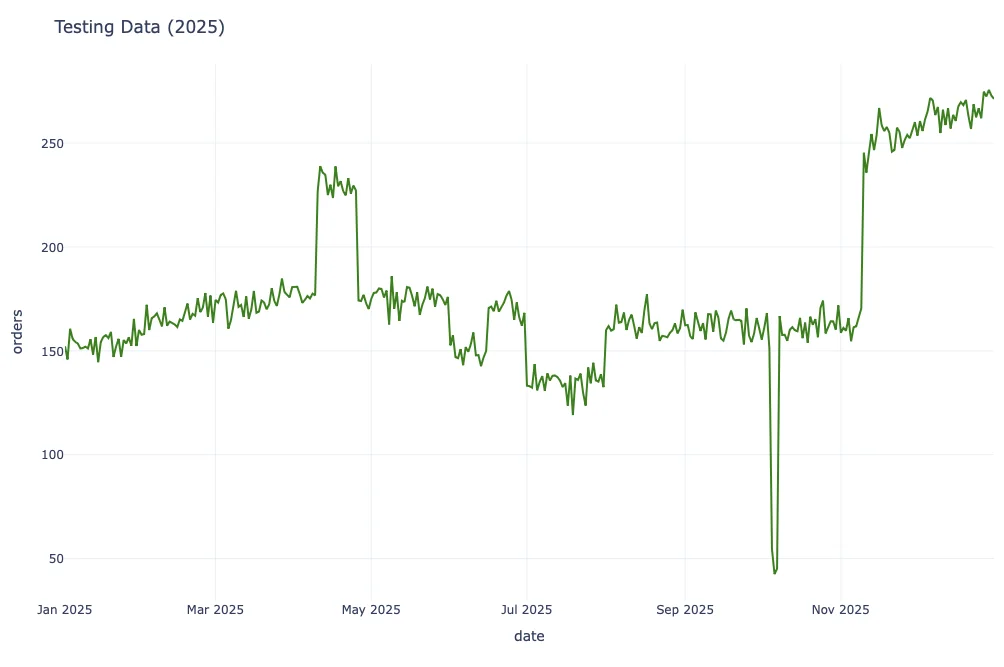
Next, I made a list of things I know about 2025.
A new subscription tier launches in Feb 2025, likely boosting orders through Q1.
A marketing push tied to an industry event in April 2025 should create a sharp demand spike.
A site redesign in June 2025 may briefly lower conversion rates while users adjust.
A typical summer slowdown is expected in July 2025 as spend and activity dip.
A holiday collaboration in Nov–Dec 2025 should drive an above-average year-end peak.
A potential data center migration in Oct 2025 could cause a short outage and small order drop.
I generated a testing set (actuals) that logically follows the training data, incorporates the known events for 2025, and includes a bit of random noise for realism.
Step 2: Prediction with original training set + Prophet (most minimal implementation)
With the training set, I train Prophet (a time series forecasting engine from Meta) to make a prediction. Remember that none of my local knowledge is accounted for in this prediction.
Here is the forecast:
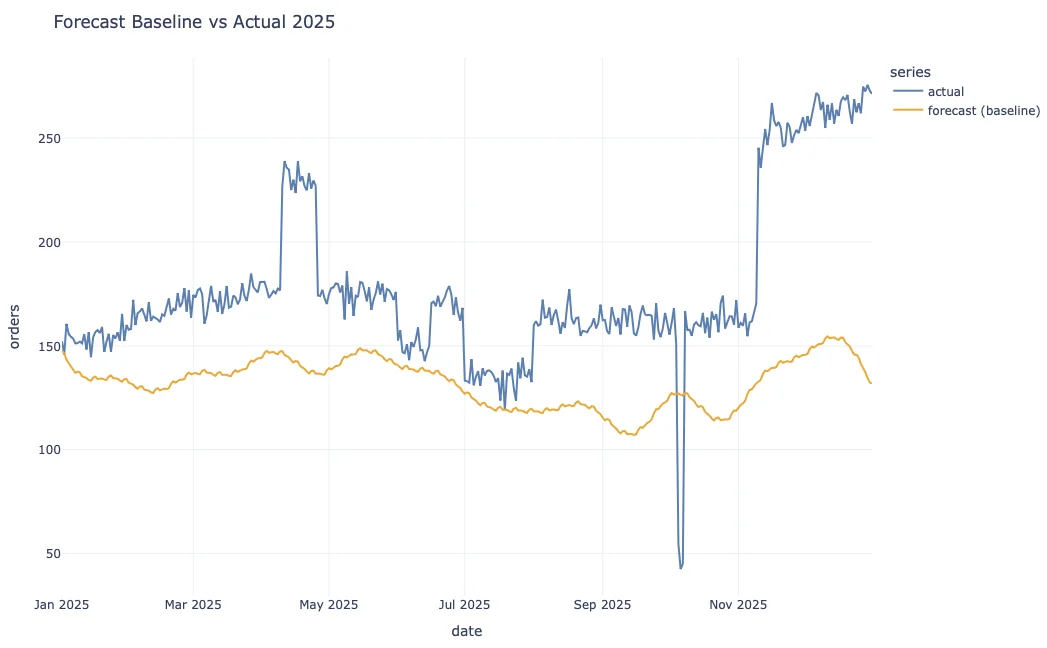
MAPE (mean absolute percentage error): 25.50%
Prophet struggled a bit. While it captured basic seasonal patterns, it completely missed the April spike and especially the Q4 surge. The forecast stayed too low and relatively flat while actual orders swung.
Step 3: Prediction with original training set + Q&A-Enhanced Prophet (Structural + Seasonal Drivers)
Now it’s time to see how AI can improve the model. I give ChatGPT the training set, tell it I plan to use it to predict 2025 sales with Prophet and request that it asks me questions to enhance the model based on my answers. Remember, it doesn’t know what I know about 2025 initially, so I hope it asks me.
Here is the transcript with ChatGPT for a conversation that took just a few minutes:
Me: I have attached a training set for 2023–2024, which I plan to use to make a time-series forecast via Prophet for 2025. This training set is just date and orders, so it’s missing structural and seasonal configs that could make the prediction more accurate. I know about events that caused up or down swings in the 2023–2024 training set, and I also know about the swings I’m expecting in the 2025 testing set that I’m trying to predict. I want to do a Q&A where you ask me questions about the swings in the training set and what swings I expect in the testing set, and you use my answers to help determine Prophet configs things like seasonalities, holidays, and changepoints but not manually adjusting for sudden dips. I want Prophet configured so it can naturally handle swings. Start asking me individual questions now one at a time, until you feel you have enough info or I tell you that’s all I know.
ChatGPT: Understood. Let’s start by identifying major repeating patterns and planned events. Were there any specific promotions, launches, or seasonality patterns in 2023 or 2024 that noticeably affected orders?
Me: We had a promo in April 2023 that produced a sharp increase in orders. November and December usually produce a decent upward trend, as they did in 2023–2024. There was a new product launch in May 2024 that created an upward shift in demand.
ChatGPT: Got it. For 2025, are you expecting similar or stronger seasonal effects, or any comparable events that should be reflected in Prophet’s configuration?
Me: The November and December effect should be larger than before in 2025. There is another marketing push in April 2025 like the one in April 2023. A new subscription tier launches in February 2025 which should steadily increase orders through the rest of Q1.
ChatGPT: That’s helpful context for Prophet’s growth and seasonality setup. Are there any recurring slowdowns or lower-demand periods we should represent as seasonal effects?
Me: Yea there’s a summer slowdown in June 2023 from vacations and less marketing. There should be a similar dip in 2025 but starting a bit later in July. There were a couple of big dips in the training set: one was a logistics bottleneck in September 2024 that messed with our inventory but we recovered quickly. We also had cloud provider outages that took down our website in February 2023 and again in August 2024. The only thing that could be like this in 2025 is a data center migration in October 2025 that could cause a brief outage.
ChatGPT: Got it. We’ll let Prophet handle those dips naturally as noise rather than model them explicitly. With your notes on promotions, seasonality, and product changes, we can now fine-tune Prophet’s yearly and monthly seasonality, add changepoints around key launch dates, and strengthen the November–December effect. Do you have any other relevant timing patterns or business cycles in mind?
Me: Nope
Here is what ChatGPT did to my forecasting script based on the Q&A:
Used Prophet with additive trend and changepoints → My input to let Prophet handle structure and seasonality naturally.
Linear growth with flexibility for known structural shifts → My input to let Prophet capture overall trends while adapting to launches and promotions.
Changepoints near April 2023, May 2024, and Feb 2025 → My input about a promotion, a product launch, and a subscription tier launch.
Strengthened yearly seasonality → My input on recurring Nov–Dec surges and summer slowdowns.
Added monthly and quarterly effects → My input on Q1 boosts (promotions, subscriptions) and Q3 dips (summer lull).
Custom seasonal boosts for April (promotions) and Nov–Dec (holiday surge) → My input highlighting April promotions and strong holiday effects.
Summer slowdown modeled around Jun–Jul, starting slightly later in 2025 → My input describing a June 2023 slowdown and later start in 2025.
Excluded sudden dips and outages, letting Prophet handle them naturally → My input not to model these manually.
Adjusted changepoint prior scale for moderate trend flexibility → ChatGPT’s adjustment based on my input to capture structural shifts without overfitting.
Kept weekly seasonality enabled → Prophet’s default behavior, consistent with my goal to keep the setup natural.
Here is the new forecast:
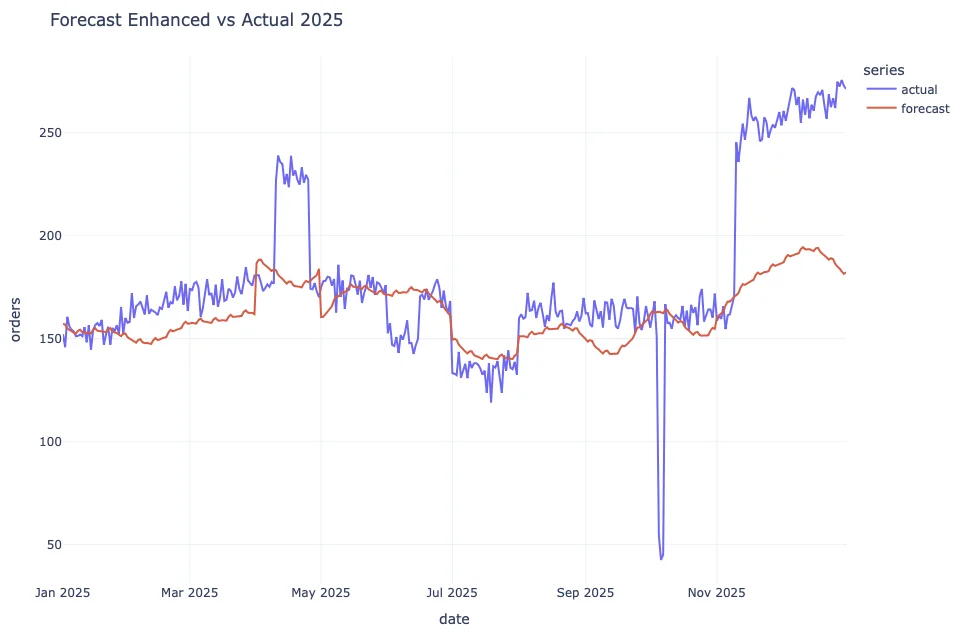
MAPE (mean absolute percentage error): 11.99%
Prophet performed better this time, capturing key structural and seasonal patterns like the April promotion, summer slowdown, and strong Q4 surge. The forecast tracked overall trends well but remained steady when actual orders spiked or dropped sharply. And this improvement came from just a few minutes of conversation with AI. In a real deployment, adding event-specific modeling or spending more time describing the events to ChatGPT would likely make the forecast even more accurate.
Step 4: Results Original vs. AI Enhanced
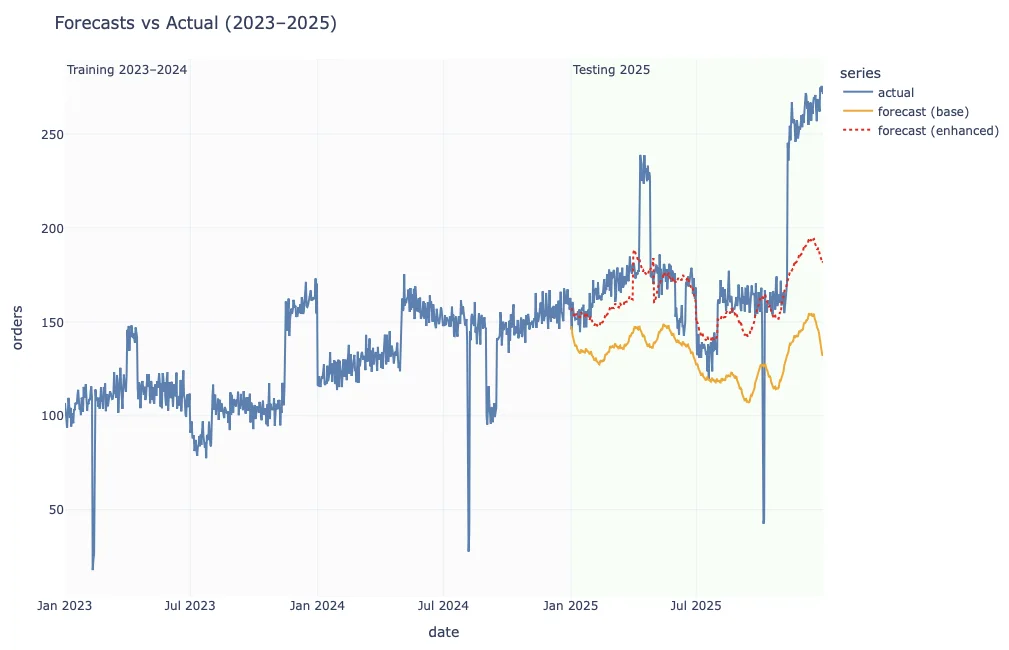
MAPE comparison:
Baseline: 25.50%
Enhanced: 11.99%
The enhanced model cut forecast error in half from a super low effort conversation with ChatGPT.
The predictive power of local knowledge
Your data will never tell the whole story. That’s what makes conversational AI valuable. It’s not just another tool for crunching numbers. It’s a way to tap into the knowledge that never makes it into your systems because it’s stuck in conference rooms and planning docs.
Pro tip: watch out for hallucinations and always review the code ChatGPT generates to ensure it makes sense, just as you would code-review with a junior analyst.